
Why Your Automatic Watch Runs Fast or Loses Time
Five to fifteen seconds a day is normal. Thirty is not. How to tell a magnetised hairspring from a dry mainspring barrel, why a watch stops or will not wind, and when a mechanical movement genuinely needs a service – from a watch repair workshop in Tbilisi.
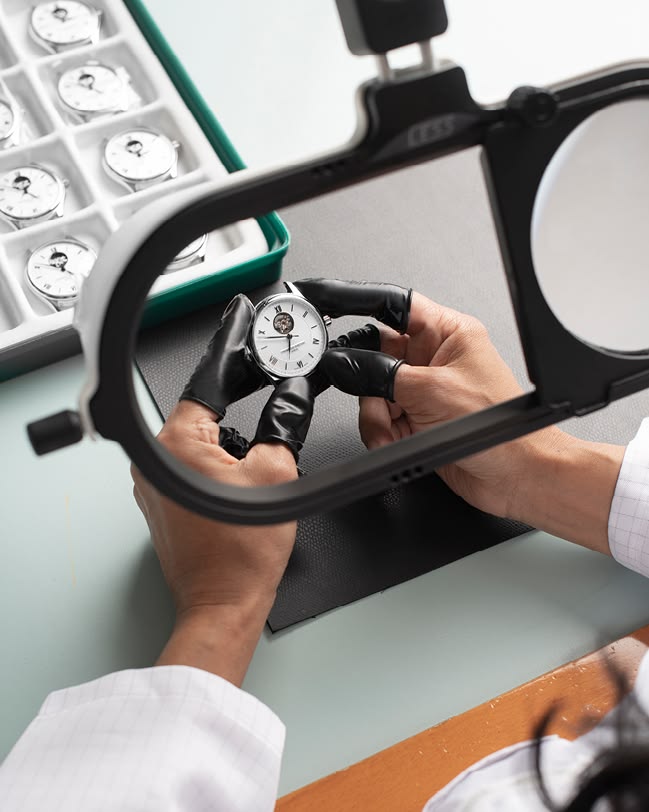
A mechanical watch is a spring driving a wheel that swings back and forth several times a second, regulated by a strip of metal thinner than a hair. It is a remarkable thing that it keeps time at all. It is not remarkable that it drifts.
The question worth asking is not why does my watch lose time – they all do – but is this normal, and has it changed. Those are two different questions and the second one matters more.
Almost everything people bring to our workshop in Tbilisi comes down to six causes: magnetism, worn lubricants, the position the watch rests in overnight, a mainspring running low on power, a knock, or a watch that was simply never regulated properly in the first place. Most of them are cheap to fix. One of them is not. Below is how to tell which you have – whether the watch on your wrist is a Rolex, a Cartier, a Patek Philippe, an Audemars Piguet or anything else with a Swiss movement inside it.
What normal looks like
A well-regulated automatic typically runs within about five to fifteen seconds a day, gaining or losing. Movements certified as chronometers are held to a tighter standard, generally in the region of four seconds slow to six seconds fast per day, tested across several positions and temperatures.
Both of those are far less accurate than a quartz watch costing a fraction as much. That is simply what a spring-driven mechanism does.
So a watch running twelve seconds fast a day is behaving normally. A watch that ran three seconds a day for years and now runs forty is telling you something.
Magnetism – the most common cause, and the cheapest to fix
If a watch suddenly starts gaining time – not losing, gaining, and often by a lot – magnetism is the first thing to suspect.
The hairspring is the regulating organ of the movement. When it becomes magnetised, its coils attract one another and stick together slightly as they breathe. A shorter effective hairspring beats faster, and the watch gains. Minutes a day is possible.
You do not need to go near anything industrial for this to happen. Speaker magnets, the clasp of a handbag, a tablet cover, a laptop, a phone holder in a car, the magnetic catch on a fridge or a cupboard door – all are enough.
Demagnetising takes moments with the right tool and usually restores the previous rate immediately. It is the single most common reason a watch is brought to us for an expensive service it does not need.
Lubricants, and the case for a service
Where magnetism makes a watch suddenly fast, worn lubricants usually make it gradually slow and erratic.
The oils inside a movement degrade over time whether or not the watch is worn. As they thin and migrate away from the surfaces they were placed on, friction rises, the balance swings through a smaller arc, and timekeeping becomes inconsistent rather than simply wrong.
Most manufacturers suggest a full service somewhere in the region of every five years, though this varies by movement and by how the watch is used. The signs are a gradual drift in daily rate, a power reserve noticeably shorter than it used to be, and a watch that keeps different time depending on how it was worn that day.
What each house actually promises
Accuracy standards vary enormously between manufacturers, which is why comparing two watches by their daily rate alone tells you very little. A figure that would be poor on one watch is entirely normal on another.
COSC is the Swiss chronometer certification, and the common baseline. A movement is tested over fifteen days in five positions at three temperatures, and must hold roughly four seconds slow to six seconds fast per day. Most certified Swiss watches you will meet are held to that.
Rolex certifies every watch to COSC and then tests it again, cased and complete, to its own Superlative Chronometer standard of minus two to plus two seconds a day. That is among the tightest figures published by any manufacturer at scale, and crucially it is measured on the finished watch rather than the bare movement. A Rolex running eight seconds fast a day is genuinely outside what it left the factory doing, even though the same figure on another Swiss automatic would be unremarkable. See the references we hold on our Rolex page, or read our guide to buying a pre-owned Rolex in Tbilisi.
Patek Philippe applies its own seal, tested on the cased watch to a tolerance tighter than COSC. Their complicated calibres – annual calendars, world time, perpetuals – are held to the same standard as the simplest. If you own one, treat any sustained change in rate as worth investigating rather than living with. Our Patek Philippe page covers the references we see most.
Audemars Piguet movements are generally COSC-comparable, and the Royal Oak's thin automatic calibres are more sensitive to a low power reserve than most – a Royal Oak worn only at weekends will often keep visibly worse time by Monday. See our Audemars Piguet page.
Cartier is the house where the question is most often answered differently, because many Cartier watches are quartz rather than mechanical. A quartz Tank or Santos keeping poor time usually needs a battery, not a service – and a quartz watch that has begun to run erratically after a battery change may simply have the wrong cell fitted. Our Cartier page lists what we hold.
Richard Mille is the exception to everything on this page. We do not open Richard Mille movements, and neither does any independent workshop with a straight answer – the manufacture does not release parts or technical documentation outside its own service network. We will inspect a piece, tell you honestly what condition it is in, and arrange a manufacture service on your behalf. Our Richard Mille page explains the position in full.
Position, and why your watch keeps different time on different days
Gravity acts on the balance wheel differently depending on how the watch is lying. Dial up, dial down, crown up, crown left – each gives a slightly different rate, and a watchmaker regulates a movement by balancing those positions against one another.
This is why the same watch can gain on a week at a desk and lose on a week of driving. It is also why resting a watch overnight in a different position can shift the daily rate by several seconds. If your watch runs slightly fast, try leaving it crown up overnight instead of dial up; the difference is often enough to correct it.
Power reserve, and the watch that stops on Monday
A rotor winds the mainspring as your wrist moves. Wear the watch daily and it stays wound. Leave it in a drawer and it runs down within its power reserve – usually somewhere between forty and seventy hours depending on the movement.
A watch worn only on weekdays is often nearly unwound by Monday morning, and a mainspring near the end of its reserve delivers less torque, which costs accuracy. If your watch keeps good time midweek and poor time on a Monday, that is not a fault.
Two other things belong here. A desk job may simply not provide enough wrist movement to keep a watch fully wound – a few manual turns of the crown in the morning solves it. And a very loose bracelet reduces winding for the same reason.
When the watch stops, or will not wind
A watch that has stopped is a different problem from a watch that runs badly, and it is worth separating the two.
If an automatic stops overnight and restarts when you shake it, it was simply unwound. If it stops while you are wearing it, the rotor may not be winding – tilt the watch gently and listen. A rotor should swing freely and silently. One that grinds, catches or rattles needs attention.
If the crown turns endlessly without resistance, the mainspring or the winding mechanism has failed and the watch needs opening. If the crown will not turn at all, stop – forcing it turns an inexpensive repair into an expensive one.
Shock and temperature
A sharp knock can shift the regulator or, in the worst case, damage a pivot. If a watch was running well and changed rate immediately after being dropped or after a day of something percussive – a hammer, a racquet, a heavy workout – treat those as related until proven otherwise.
Temperature has a milder effect. Modern hairspring alloys compensate for it well, and in ordinary wear it is not something to worry about.
What we see most often, by house
After a year of watches across the bench at Merab Kostava Street, the pattern is fairly consistent.
- Rolex – sudden gain, almost always magnetism. Demagnetised in moments, and the rate usually returns immediately.
- Cartier – battery, seal or crown. On the quartz references it is very often simply the cell.
- Patek Philippe and Audemars Piguet – low amplitude from tired lubricants, and on sport references a bracelet loose enough to reduce winding.
- Vintage pieces of any house – a movement that has been apart before, and not carefully.
Whatever is on your wrist, the diagnostic is the same and it costs nothing. The full range of houses we hold is on our brands page, and what a service involves is set out on our watch service page.
When to have it looked at
- A sudden change in rate, particularly a watch that has become fast. Suspect magnetism first.
- More than about thirty seconds a day, consistently, on a watch that used to do better.
- A power reserve noticeably shorter than it once was.
- A rotor that no longer spins freely, or that grinds or rattles when you tilt the watch.
- Condensation under the crystal – that is a seal problem and it will not improve on its own.
- A watch that stops on the wrist, or a crown that turns without resistance.
- Five years or more since the last service, even if nothing seems wrong.
And one case where the answer is to do nothing: a watch that has always run ten seconds fast and still does. That is a healthy watch. Set it on a Sunday and leave it alone.
Not sure which one it is?
Bring the watch in and we will tell you. A diagnostic on a timing machine takes a few minutes, covers accuracy across positions, power reserve and water resistance, and costs nothing – including when the answer is that your watch is simply magnetised and needs no work at all.
Our workshop in Tbilisi handles movement servicing, demagnetising, accuracy regulation, water resistance testing, crystal replacement, polishing and battery changes, on Swiss mechanical and quartz watches alike. See what a full service involves on our watch service page, read our guide to reading a watch movement, or visit us at 45G Merab Kostava Street. Call +995 555 86 88 88.