
Water Resistance Explained: 30m, 50m, 100m
The numbers on your caseback are a laboratory figure, not a swimming licence. What each rating actually allows, why gaskets matter more than the number, and when to have a watch pressure tested.
Almost everything people believe about water resistance is wrong, and the reason is that the number on the caseback looks like a depth. It is not a depth. It is a laboratory figure, produced under conditions your watch will never meet on a wrist.
Understanding what the number actually describes is the difference between a watch that survives a decade of ordinary life and one that comes into our workshop with condensation under the crystal.
The number is a static pressure, not a depth
A watch marked 50m has been tested in a chamber at a pressure equivalent to fifty metres of water, held still, at room temperature, when new. Nothing moves. There is no current, no temperature change, no impact.
Water in the real world does not behave that way. Swinging your arm through water briefly multiplies the pressure at the case many times over. Diving into a pool does the same. A watch rated to fifty metres is not rated for fifty metres of swimming – it is rated for a static pressure it will almost never experience so gently.
This is why the industry guidance is consistently more conservative than the number suggests.
What each rating actually allows
- 30m / 3 ATM – rain, splashes, washing your hands. Not swimming. Not showering.
- 50m / 5 ATM – brief, shallow swimming. No diving in, no jumping, no water sports.
- 100m / 10 ATM – swimming and snorkelling comfortably. Still not scuba.
- 200m / 20 ATM and above – serious water use. This is where genuine dive watches begin.
ATM and metres describe the same thing: 10 ATM is 100m. If a watch carries no water resistance marking at all, treat it as having none.
One marking is worth more than the rest. A watch marked DIVER'S has been certified to the ISO standard for diving watches, which tests considerably more than static pressure – resistance to salt water, to condensation, to thermal shock, and the legibility of the bezel and markings in darkness. A watch rated to 200m without that marking has passed a pressure test. A watch marked DIVER'S 200m has passed a great deal more.
The rating is only as good as the gaskets
Water resistance does not come from the case. It comes from rubber seals – at the caseback, at the crown, at the crystal, and behind every pusher. Those seals are consumable parts.
They harden and shrink with age whether the watch is worn or not. They degrade faster with heat, with soap, with chlorine, with sun cream, and with salt. A five-year-old gasket that has never touched water is still a five-year-old gasket.
Which means the number stamped on your caseback describes the watch as it left the factory, not the watch you are wearing today. A twenty-year-old watch marked 100m may be perfectly sealed or may be wide open, and there is no way to tell by looking. That is what a pressure test is for.
What actually causes the damage
Hot water and steam
The most common single cause we see. Showers, baths, saunas and hot tubs all combine heat with water, and heat is the problem: gaskets expand and contract, and steam molecules pass through gaps that liquid water would not. A watch that survives the sea can be ruined by a sauna.
Soap, chlorine and salt
All three attack rubber. Chlorinated pool water and sea water are considerably harder on seals than fresh water. If you swim in either, rinse the watch under a tap afterwards and dry it – it takes ten seconds and it meaningfully extends the life of the gaskets.
The crown
An unscrewed screw-down crown makes a 300m dive watch about as water resistant as an open window. Check it is fully home before any contact with water. And never operate the crown or a chronograph pusher while the watch is wet, let alone submerged – that is a direct channel into the movement.
Age, on vintage pieces
Treat any vintage watch as not water resistant regardless of what the dial or caseback claims, unless it has been tested recently. Original gaskets from decades ago are not doing their job, and the cost of finding out the hard way is a movement.
Condensation: what it means and what to do
Mist under the crystal means water has already entered the case. It is not a cosmetic problem and it will not dry out on its own in any useful way.
Water inside a movement begins to corrode steel components within days, and the damage is often more expensive than the service that would have prevented it. If you see condensation, stop wearing the watch and bring it in. Do not leave it in rice, in the sun, or on a radiator – heat drives moisture further into the movement and can damage the dial.
How often to have it tested
Once a year if you swim with the watch. Every time it is opened for any reason, because the seals are disturbed. And always before a holiday, which is when most water damage actually happens.
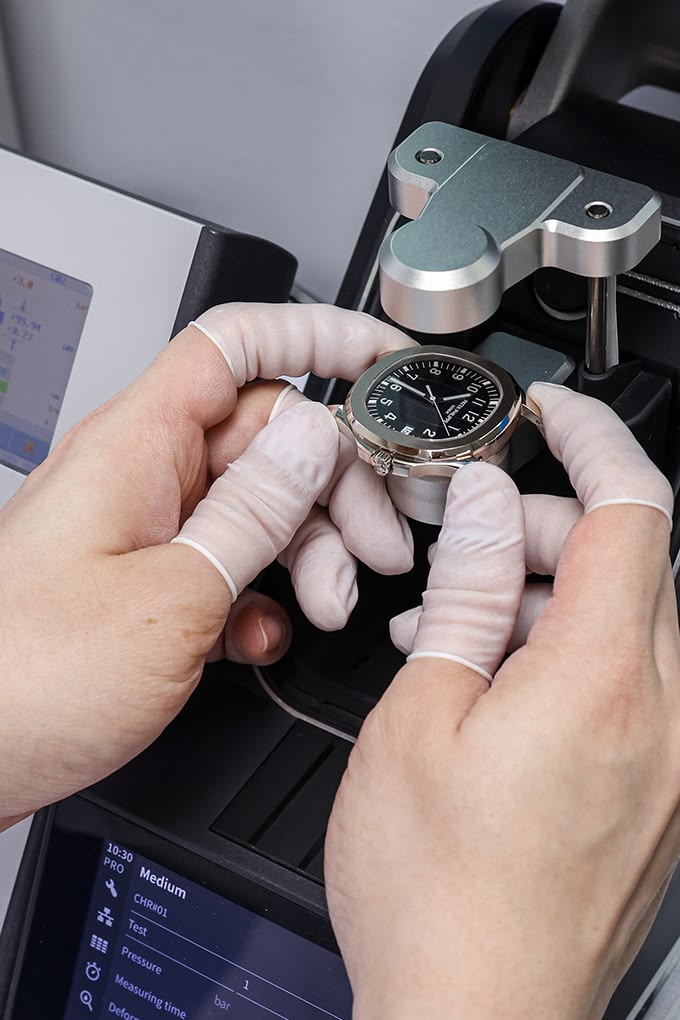
The test itself is quick. A dry test measures how the case deforms under pressure and detects a leak without any water touching the watch. A wet test submerges the watch under pressure and looks for bubbles. Neither takes long, and either one tells you what the number on your caseback cannot.
The short version
- Treat the rating as roughly half of what it says. The margin is where real-world conditions live.
- 30m is not a swimming watch. Whatever the number looks like.
- Never shower in it. Heat is harder on seals than depth.
- Screw the crown down. Every time, before water.
- Rinse after sea or pool. Ten seconds of fresh water.
- Test yearly. The rating ages even when the watch does not.
Have your watch tested before the next holiday
Our workshop in Tbilisi carries out water resistance testing with specialised equipment, and the diagnostic costs nothing. We test the case, the crown and the seals, tell you what the watch is genuinely rated for today rather than what it was rated for when new, and replace gaskets where they are needed. See what a full service involves on our watch service page, or visit 45G Merab Kostava Street. Call +995 555 86 88 88.